Jonathan Edwards Quotes
Among the many acts of gratitude we owe to God, it may be accounted one to study and contemplate the perfections and beauties of His work of creation. Every new discovery must necessarily raise in us a fresh sense of the greatness, wisdom, and power of God.
Edwards, Jonathan. "Of Insects." The Works of Jonathan Edwards, Vol. 6: Scientific and Philosophical Writings. Edited by Wallace E. Anderson, Yale University Press, 1980, p. 154.


At the time, it was very difficult for people who had been taught all their lives that God was directly responsible for the creation to accept the notion of evolution. At the time, there was not the overwhelming evidence proving Darwin’s theory that we have today. Nor did theologians realize that evolution and Darwinism were not inconsistent with the concept of a creator and supreme being. Nonetheless, there are still those who, like Agassiz, reject evolution and insist that the Biblical version of creation is literally true. See {586990}. Then there are people who have come up with the concept of Intelligent Design which originated with Agassiz though he never called it that. Most religious people today, in contrast, see no conflict in natural selection as described by Darwin and later proven, and the concept of God. They see the Biblical creation as metaphorical and natural selection as the product of an omniscient supreme being.


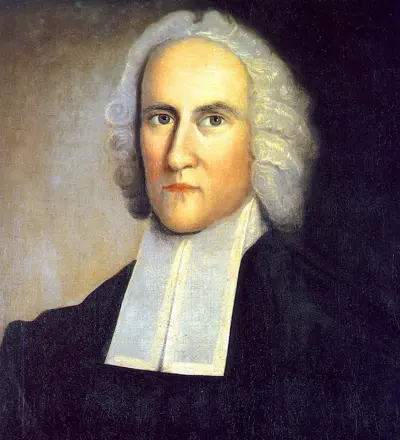
Jonathan Edwards was an American revivalist preacher, philosopher, and Congregationalist Protestant theologian. Edwards is widely regarded as one of America's most important and original philosophical theologians. Edwards' theological work is broad in scope, but rooted in the pedobaptist Puritan heritage as exemplified in the Westminster and Savoy Confessions of Faith. Recent studies have emphasized how thoroughly Edwards grounded his life's work on conceptions of beauty, harmony, and ethical fittingness, and how central The Enlightenment was to his mindset. Edwards played a critical role in shaping the First Great Awakening, and oversaw some of the first revivals in 1733–35 at his church in Northampton, Massachusetts. His theological work gave rise to a distinct school of theology known as the New England theology.
