Xenophanes Quotes
All things that come into being and grow are earth and water.
Kirk, G. S., J. E. Raven, and M. Schofield. The Presocratic Philosophers. 2nd ed., Cambridge University Press, 1983, p. 175.


Darwin who had a Protestant Christian upbringing, never precluded the possibility that God had created the universe with the Laws of Evolution and that was the mechanism He selected to allow all the species and diversity of life to develop. But he did not say that explicitly. While he found immediate acceptance and accolades from the scientific communities throughout the world, and enthusiastic approval by most educated people with the exception of theologians and clerics. Their reaction was extreme—almost apoplectic. The book as a best seller and they sold out with each successive printing. In the 6th edition, Darwin not only was explicit about the role the Deity might have had, but Darwin stated that he personally believed that He was the impetus to the creative process. Ironically, almost all the social and political opponents of Evolution have never read Darwin’s work (or much else on the subject) and certainly do not realize that the man they accuse of leaving God out of the Creation, actually believed that God was the critical element and he and other evolutionary scientists were just discovering God’s laws. Dr. Huxley and some other supporters of Darwin were disappointed with this change in the 6th edition, as they were atheists and believed that there was no deity involved in the creation. Today, there are evolutionary scientists who are on both sides of the issue. They just disagree on this point, but they work together on everything else.


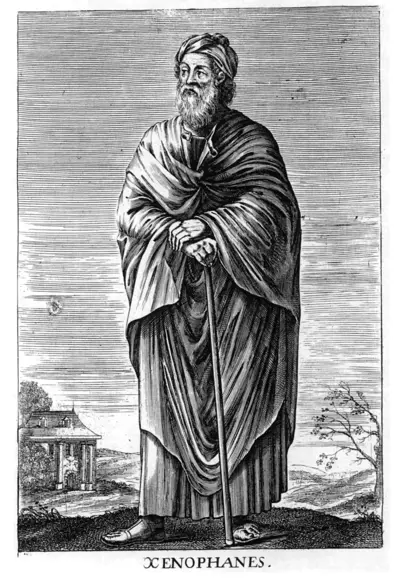
Xenophanes of Colophon (/zəˈnɒfəniːz/; Ancient Greek: Ξενοφάνης ὁ Κολοφώνιος [ksenopʰánɛːs ho kolopʰɔ̌ːnios]; c. 570 – c. 478 BC) was a Greek philosopher, theologian, poet, and critic of religious polytheism. Xenophanes is seen as one of the most important Pre-Socratic philosophers. Eusebius quoting Aristocles of Messene says that Xenophanes was the founder of a line of philosophy that culminated in Pyrrhonism. This line begins with Xenophanes and goes through Parmenides, Melissus of Samos, Zeno of Elea, Leucippus, Democritus, Protagoras, Nessas of Chios, Metrodorus of Chios, Diogenes of Smyrna, Anaxarchus, and finally Pyrrho. It had also been common since antiquity to see Xenophanes as the teacher of Zeno of Elea, the colleague of Parmenides, and generally associated with the Eleatic school, but common opinion today is likewise that this is false.
