Evo Morales Quotes
All of Africa's resources should be declared resources of the state and managed by the nation. Our experience in Bolivia shows that when you take control of natural resources for the people of the town and village, major world change is possible.


Sealed under duress and later repudiated by the King with Papal assistance. This clause was particularly interesting in that almost all freedoms have expanded from the Magna Carta in modern democracies. However in this one there was an absolute direct prohibition against the King—the State—taking private property without the owners consent. In modern democracies the right is not as strong as the original. The state, if it needs the property, wood or whatever, and the owner refuses to give it or sell it to the state, the government can condemn the property but must pay the owner the fair market value of the property seized. As a practical matter, the kings of England paid little or no heed to this clause. One of the sources of conflict between the English Royal Navy and the American Colonists was the practice of Naval agents finding tall straight trees, good for the main mast of a ship, and marking it thereby prohibiting the property owner of cutting down that tree until the Crown sent a crew to fell the tree and take it for ship building. They paid no attention to Aticle 31 whatsoever.


Previous governments had attempted to privatize the economy and sold off many of the nationally owned enterprises. Morales, a socialist, began reversing the cycle and “nationalized” the natural gas supply which is plentiful. Bolivia had been getting a very small percentage compared with world standards and Morales renegotiated the percentage for the government, but left the management in private hands. So in that sense he did not “nationalize” the hydrocarbons. The Bolivian mines represented another problem entirely. For years, featherbedding had created tens of thousands of unnecessary jobs for the mining, nut necessary to the people who were employed and the economy. But private operators always wanted to reduce the number of workers to only what was needed. So the nationalization problem was to increase the productivity of the Bolivian mines, maintain the exports of the mined products and maintain the employment---a difficult balancing act.
The founder was Charles E. Coughlin, 1891-1979, a demagogic Catholic Priest who drafted the principles and invited others to join him. Hundreds of thousands did in this organization which began in idealism, and ended in scandal and hate mongering, so much so that Father Coughlin was ordered off the radio and out of politics by the Catholic Church. The National Union in 1936 had morphed into the Union Party which ran Presidential candidates in the 1936 election. The Coughlin and the Union were a mixture of Fascist and Socialist principles. The prohibition of private ownership of banks and utilities was one of the radical socialist notions.


This constitution greatly limits the role of private property ownership.


Nigeria had an abundance of natural resources including oil. However, they had one of the most corrupt countries in the world.
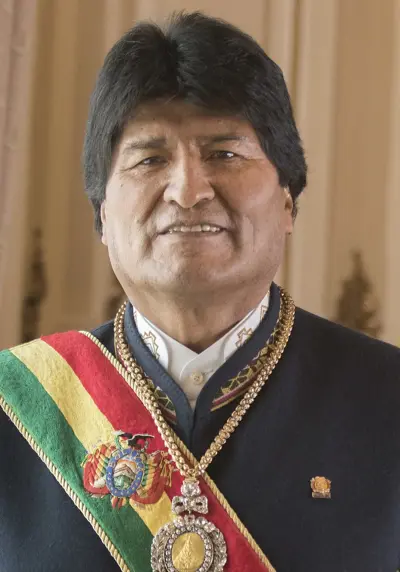
Juan Evo Morales Ayma is a Bolivian politician and former cocalero activist who served as the 65th President of Bolivia from 2006 to 2019. Widely regarded as the country's first president to come from its indigenous population, his administration focused on the implementation of leftist policies and combating the influence of the United States and multinational corporations. Ideologically a socialist, he has led the Movement for Socialism (MAS-IPSP) party since 1998.
