Mahatma Gandhi Quotes
All compromise is based on give and take, but there can be no give and take on fundamentals. Any compromise on mere fundamentals is a surrender. For it is all give and no take.
Gandhi, Mahatma. Harijan. 30 Mar. 1940.


Some politicians tell their constituents that they compromise but not on principles. This is illusory and often disingenuous as well. In a democracy there are many sets of principles that conflict with others just as deeply and frequently held. Even many of the principles of the U. S. Constitution conflict with other constitutional principles. If politicians never compromised on principles and ideals, there would be no operational government unless it were a theocracy or a dictatorship where there were only one set of principles in the society. The more democratic a society is the more its politicians must compromise with their fundamental principles and ideals.


This argument is is usually made by the right wing. However, this quotation is notworthy because it was made by a left wing liberal.

One of the most effective Senators, she became more and more frustrated as her party was dragged into obstructionism and hyperpartisanship by ultra conservative but inexperienced Tea Party Republicans who saw every compromise as treason to the party and a craven sell out of principle. They were not able to pass a single law however, and Snowe chose not to run despite an easy reelection and tried to reform the Congress from the outside.

As the Majority Leader of the House, Eric Cantor had to resolve conflicts and for coalitions that will compromise to get anything done. However, the Tea Party movement didn’t want any compromises even if it meant shutting down the government and defaulting on the national debt. They ran against conservative Republicans in the Republican primary elections campaigning that the incumbent made and facilitated compromises with Democrats. In some districts like Eric Cantor’s there were enough primary voters who agreed. Terry was explaining the message that the other conservative politicians received.

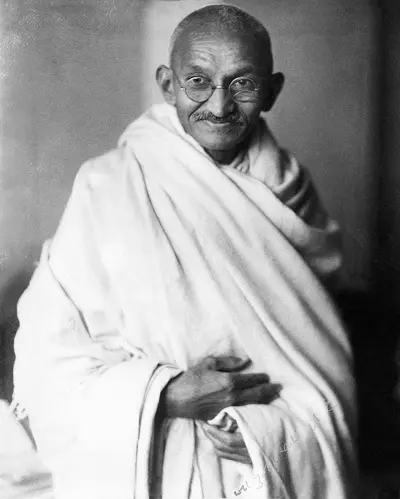
Mohandas Karamchand Gandhi was an Indian lawyer, anti-colonial nationalist, and political ethicist, who employed nonviolent resistance to lead the successful campaign for India's independence from British rule, and in turn inspired movements for civil rights and freedom across the world. The honorific Mahātmā (Sanskrit: "great-souled", "venerable"), first applied to him in 1914 in South Africa, is now used throughout the world.
