Scott Gottlieb Quotes
Advocacy groups like Families U.S.A. imagine that once Medicaid becomes a middle-class entitlement, political pressure from middle-class workers will force politicians to address these problems by funneling more taxpayer dollars into this flawed program. President Barack Obama's health plan follows this logic.
Gottlieb, Scott. "The Public Option Is Really Medicaid." The Wall Street Journal, 31 July 2009.


That particular Libertarian platform called for the abolition / repeal of Social Security, Medicare, Medicaid, the Post Office, Federal election Commission and campaign finance laws. Extreme radical ideas such as this are not typical of Libertarian Party positions before or afterwards. The quotation illustrates that there are people in America who would end public education if they could. The quotation also illustrates how a small cadre of people can capture control of a political party and create a platform that is their own personal views which may be different from most of the party members or the historical position that the party has taken. In 1980 the Libertarian Party Vice Presidential Candidate was David Koch, one half of the billionaire conservative Koch brothers. Their money financed the Libertarian Party in that year and David Koch’s views then prevailed in the party platform. Historically, the Koch brothers moved from a minor third party to the Republican party at the beginning of the 21st century when their money was able to help drive the party very far to the right from the traditions of Abraham Lincoln and Theodore Roosevelt.

A single payer system for health insurance saves an enormous amount of money—15 to 20 percent of all health payments made under all health insurance. However, this quotation from a leading Republican disclosed a split in the Republican Party. Many really would like the many billions of dollars that would be saved every year by having one organization pay all health insurance bills as Medicare did, but the large insurance companies, major contributors to Republicans, of course did not want to compete for the single payer where most would lose their administrative overhead and profits from the existing inefficient system. So austerity, normally a strong Republican principle, gave way to the profits of an important Republican contributor base.

The reason this quotation is noteworthy is the reality that Medicare is the largest Federal Government program that there is. It is not only funded by the Government, but Government employees actually operate it from making the policies to paying the tens of millions of bills to doctors and hospitals. The protester who created the sign, like the overwhelming majority of Tea Party enthusiasts are opposed to big government and especially to government involvement in any health care operations. Obamacare was very controversial and most Tea Party enthusiasts were lobbying heavily against the Government “taking over” the American health care system. Medicare is one of the most popular Federal programs in American history and many people who were opposed to Federal health program management and were ignorant of the fact that Medicare was operated by the Government, were expressing their concern. The sign did not seem to distress any of the thousands of Tea Party followers in the audience, but the main takeaway was that there were many American who just assumed that anything that was run well and they liked could not be run by the government.


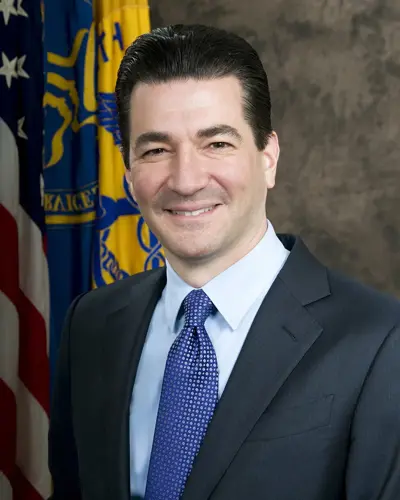
Scott Gottlieb is an American physician and investor who served as the 23rd commissioner of the Food and Drug Administration (FDA) from 2017 until April 2019. He is presently a resident fellow at the conservative think tank the American Enterprise Institute (AEI), a partner at the venture capital firm New Enterprise Associates (NEA), a member of the board of directors of drug maker Pfizer, Inc, a member of the board of directors of Illumina, Inc., and a contributor to the cable financial news network CNBC. Before becoming FDA commissioner, he was a clinical assistant professor at New York University School of Medicine, the FDA deputy commissioner for medical and scientific affairs, a venture partner with New Enterprise Associates, a member of the policy board of the Leukemia & Lymphoma Society, a senior official at the Centers for Medicare and Medicaid Services, and a member of the Federal Health Information Technology Policy Committee, which advises the United States Department of Health and Human Services on healthcare information technology. He was previously a resident fellow at AEI from 2007 to 2017 prior to joining the FDA as commissioner in May 2017.
