Herodotus Quotes
A man calumniated is doubly injured - first by him who utters the calumny, and then by him who believes it.
Herodotus. The Histories. Translated by George Rawlinson, John Murray, 1862, p. 11.


Calumnaire fortiter, et aliquid adhaerebit. See Pierre Beaumarchais for a later version of this political tactic.


Comey was objecting to the firing of several Assistant Attorneys General whom he thought were victims of parisanship.


This quotation is the root of a great dilemma for all politicians who are attacked on a personal level. Most slanders are soon forgotten. The politician who reacts and publicly counters the slander inevitably does two things. More people become aware of the slanderous charges then there is a public battle over it, and the media tend to report the contest and hence the slanderous charge for a longer period of time than if it were uncontested. However sometimes the undefended charge is perceived as being true especially if it is a major charge. If the politician does not defend, the charge can get accepted and damage the politician’s standing. In the Kerry-Bush Prudential campaign, Kerry had the edge until the so-called Swiftboat Veterans made up a fictitious tale of Kerry, a decorated war hero, being a coward in the Vietnam war. Kerry thought the charge so preposterous that he didn’t bother to defend it. His lack of reaction was taken by much of the public as his admission of the charge. Kerry’s hero image was destroyed by a large enough proportion of the electorate that the electoral votes shifted to Bush, even though Kerry had the most votes by far. For each politician, the decision must be made for each charge and there is no clear way to know in advance which is the better strategy when a false charge is made.


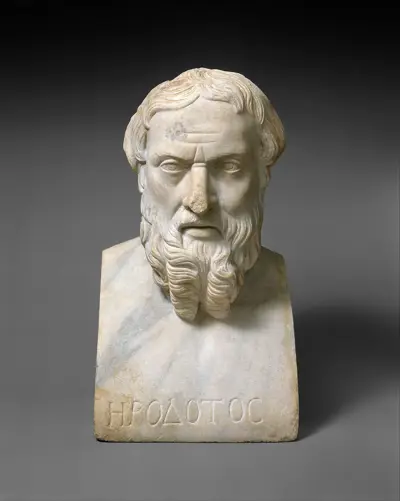
Herodotus (/hɪˈrɒdətəs/; Ancient Greek: Ἡρόδοτος, Hēródotos, Attic Greek pronunciation: [hɛː.ró.do.tos]; c. 484 – c. 425 BC) was an ancient Greek historian who was born in Halicarnassus in the Persian Empire (modern-day Bodrum, Turkey). He is known for having written the book The Histories (Ancient Greek: Ἱστορίαι Historíai), a detailed record of his "inquiry" (Ancient Greek: ἱστορία historía) on the origins of the Greco-Persian Wars. He is widely considered to have been the first writer to have treated historical subjects using a method of systematic investigation specifically, by collecting his materials and then critically arranging them into a historiographic narrative. On account of this, he is often referred to as "The Father of History," a title first conferred on him by the first-century BC Roman orator Cicero.
