Seneca the Younger Quotes
A hated government does not long survive.
Seneca, Lucius Annaeus. Seneca's Tragedies, Volume II. Translated by Frank Justus Miller, G. P. Putnam's Sons, 1917, p. 397.


Fiji had undergone attempted coups where the nation was polarized. The issue of whether and how much to punish the coup attempters was very controversial.


1st Earl of Beaconsfield


The American Revolution was a trying time, not only militarily but in just about every other way as well. Washington was quite pessimistic in 1778 as this quotation demonstrates. But it was to get worse. See {624230}. And the rapacity even extended to war profiteering. {624227}.


President Ngo Dinh Diem of South Vietnam Diem was a creature of the Central Intelligence Agency. An anti-Communist Christian in a Buddhist county, the CIA engineered his rise to power, created his political party, provided him with cash to bribe other Vietnamese politicians, and paid for all the propaganda so he would “win” the Presidential elections. However, he abused the Buddhists, was thoroughly corrupt and ran a corrupt administration, but worst of all from the American point of view, he was unable to motivate the South Vietnamese population to fight the Communists. He reached the point where he was more of a liability, and the Central Intelligence Agency engineered a coup d’etat to remove him from power and replace him with a President more to our liking. (See {634540}.) Another reason this quotation is important is that it demonstrates the involvement that the Attorney General had with foreign and defense policy. Normally the Attorney General has nothing to do in these areas and is not even in the loop. But Robert F. Kennedy was also the President’s brother, and his advice was sought by President Kennedy on almost all matters. He was probably the most influential attorney general in American history.

the Dutch monarchy supported by England The French fear of course was that the revolutionary fervor spreading to the bourgeois could easily spread to France, and that is exactly what happened 4 years later. See {639769} for more of his view on the Dutch revolutionary spirit that might infect France.
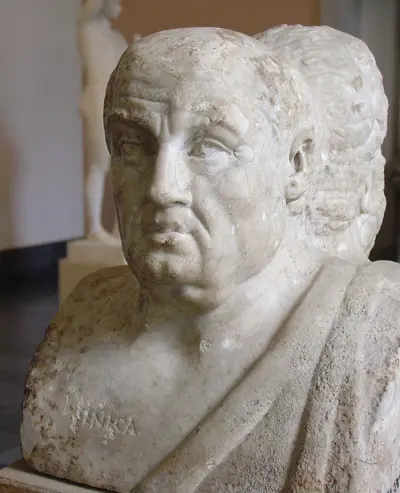
Lucius Annaeus Seneca the Younger (/ˈsɛnɪkə/; c. 4 BC – AD 65), usually known as Seneca, was a Roman Stoic philosopher, statesman, dramatist, and in one work, satirist from the Silver Age of Latin literature.
