Aristotle Quotes
A democracy is a government in the hands of men of low birth, no property, and vulgar employments.
Aristotle, 384-322 BC, Greek Philosopher & Teacher, Politics, 343 BC
Sourced by: Eigen's Political and Historical Quotations


Although friendly to America, Canning was a monarchist and did not share America's enthusiasm for democracy and concern about Spanish Princes in Mexico and Brazil.


This concept was utilized by the U. S. State Department in opposition to the 1992 dissolution of the Peruvian Congress by the President who claimed he was doing it for democratic reasons. See Al Smith for a later expression of this notion.


This is a very important quotation. Abraham Lincoln obtained a printed copy of Parker’s sermon and underlined this quotation on his copy. Later when he was President he used a slight variation of Parker’s last phrase in the last line of his famous Gettysburg Address.


See 358821 for another expression of this idea.


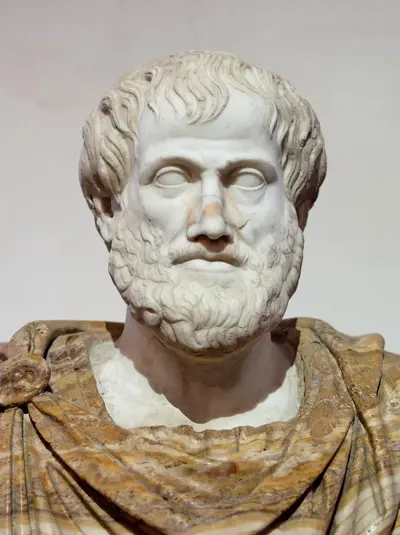
Aristotle (/ærɪˈstɒtəl/; Greek: Ἀριστοτέλης Aristotélēs, pronounced [aristotélɛːs]; 384–322 BC) was a Greek philosopher and polymath during the Classical period in Ancient Greece. Taught by Plato, he was the founder of the Lyceum, the Peripatetic school of philosophy, and the Aristotelian tradition. His writings cover many subjects including physics, biology, zoology, metaphysics, logic, ethics, aesthetics, poetry, theatre, music, rhetoric, psychology, linguistics, economics, politics, meteorology, geology and government. Aristotle provided a complex synthesis of the various philosophies existing prior to him. It was above all from his teachings that the West inherited its intellectual lexicon, as well as problems and methods of inquiry. As a result, his philosophy has exerted a unique influence on almost every form of knowledge in the West and it continues to be a subject of contemporary philosophical discussion.
